"Take it or leave it" is a negotiation tactic. There are many bargaining situations in which it is appropriate. This negotiation tactic has a legitimate place in your negotiating tool kit.
Much of today's business is conducted on a "take-it-or-leave-it" basis, whether we like to call it that or not. When you go into a retail store you see items clearly marked with a price. Some prices, like your electrical or water bill, are fixed by regulations. Many industrial goods and services are sold at the same price to all customers.
"Take it or leave it" is not as ominous as it sounds. It often represents good pricing policy for the seller, and a better way for the buyer to buy.
"Take it or leave it" makes sense under the following conditions:
* When you don't want to encourage future negotiating.
* When the other party is under a lot of pressure to say "yes" to what you propose.
* When a drop in price to one customer will force a drop to all customers.
* When others have already accepted your proposition.
* When you can't afford to risk a loss because you are selling at the lowest possible price.
* When you want to signal the other party that you have gone as far as you are going to go.
If you are going to use "take-it-or-leave-it" in your negotiation, there are ways to minimize hostility. Never use the expression itself because the words alone are enough to anger the other person.
"Take-it-or-leave-it" positions that are backed by legitimacy are less offensive. When a firm position is backed by regulations, published policies, clearly observed price tickets, or customary trade practices, it tends to be accepted more easily. The same is true when your firm position is accompanied by a good explanation and positive proof statements.
People are more willing to accept a "take-it-or-leave-it" later in a negotiation than earlier. Timing is important in reducing hostility.
"Take-it-or-leave-it" is a legitimate tactic in negotiation. A surprising number of people welcome it because it saves them the trouble of bargaining. If you are going to use it, there are three things you must do. First, give the other party all the time needed to discuss the matter; and second, be sure to tell your boss, or your team, that you are going to use it. The person who forgets this is could be in real deep trouble. Finally, if you use 'take-it-or-leave-it' as a negotiating tactic, remember it could result in a 'dead lock'. You need to plan for this. If you really want, or need, to come to an agreement with the other party, determine which techniques you will use to re-open negotiations should a 'dead-lock' occur.
Dr. Chester L. Karrass brings extensive experience, advanced academic credentials in negotiation techniques, and over 35 years experience in seminar delivery. After earning an Engineering degree from the and a Masters in Business, Dr. Karrass became a negotiator for the Hughes organization.
Related: Negotiation Training
Free Downloads
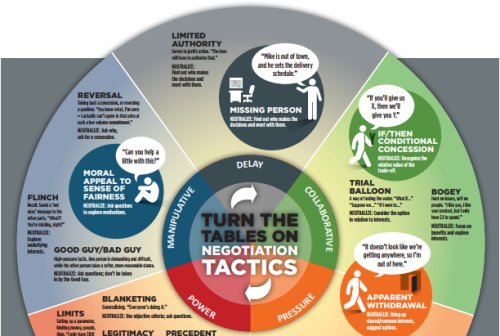
Neutralizing Negotiation Tactics
Public Negotiation Training