On numerous occasions, I have participated in negotiations as a technical consultant on behalf of clients. In order to save time and money, the client often prepares for these negotiations themselves. Through many previous bad experiences, I have learned to ask clients in advance what their idea of negotiation strategies and being prepared actually is. Their answers often show, however, that they are not yet ready to begin an effective negotiation session.
Inexperienced, lazy, or naive negotiators believe that being prepared means 'knowing what they want' out of the negotiations, which generally implies that they have decided on terms that they would be happy with. They may even have given some thought to their worst case scenario, but that tends to be the extent of their negotiation strategies and preparations.
Knowing what you want from a negotiation is only a small part of what it takes to be prepared. The key to success is knowing how you are going to get what you want. Success comes from having effective negotiation strategies that convince the other side that what you want is actually fair and reasonable - or, at the very least, inevitable.
Ill-Prepared Negotiators
Most negotiators do not prepare appropriately. Even when large amounts of money are involved, people typically rely on past or similar situations to determine negotiation strategies. They expect to use their wits and develop a strategy on the fly. At best, planning for an effective negotiation session is one-sided and incomplete.
Skilled negotiators love ill-prepared opponents because their negotiation strategies are easier to manipulate. The lack of effective negotiation preparation on the part of their opponent makes their job much easier and allows them to overwhelm the other side with a higher degree of knowledge, preparation, research, and hard-hitting demands.
Being prepared requires that you have some idea of the other party's desired outcomes. A plan is only realistic if you know what the other side wants, and you've figured out a way to give it to them (while getting what you want) or have figured out a way to change their minds to agree with your demands. The more you know about what the other team wants the less there is to negotiate and the easier it is to get an equitable agreement through a stream-lined, effective negotiation session.
Determining Failure or Success
Success is determined when a mutual agreement is met and both sides are satisfied without any hard feelings. To achieve this, you'll need to consider the other side's needs as well as your own.
After all, an effective negotiation should not be a winner-take-all type of contest. The vast majority of negotiations take place with people who you will need to work with after the negotiations have come to a close. If they feel cheated or resentful about a deal that was struck, the working relationship will be harmed.
Failure is judged in terms of potentially damaged relationships or by a deal that you are unhappy with. A failed negotiation might very well be the one in which you got everything you wanted (or thought you did) but ended up damaging your working relationship with a colleague, supplier, or competitor.
It is not uncommon for the purchasing department of large companies to squeeze small suppliers and contractors to the point where there is no profit (or incentive) in the contract that is ultimately signed. The result is a contractor that provides minimal or poor quality service and products. In this context, who is the winner of the negotiations? No one is. Everyone loses.
Successful Preparation Tactics
When planning effective negotiation strategies, it's best to develop a list of objectives for ourselves and imagine what the position would be for the other side. Are they likely to agree to our terms or not? If not, why not? What would they agree to? Taking a win-win approach to effective negotiation strategies creates allies not enemies.
For an effective negotiation session, strategize with the big picture in mind: focus on long-term objectives, not short-term. Preserve relationships even if at the cost of short-term victories. And remember that the next negotiation begins the minute the last one ended. Being prepared means knowing how you are going to get the other side to agree and be happy with the deal you want or need. Being prepared requires planning, strategy, and tactics.
Strategy is developed from your analysis of what are reasonable targets and objectives. Your negotiation strategies are your approach to how you are going to convince the other side to agree to what you want. Tactics are specific, identifiable manoeuvres that implement the negotiation strategies.
Consider this example - a car salesman wants to sell cars for as much as possible. You want to pay the least. But does the car salesman also want you as a long-term customer? Do they want a trade-in car from you? Do they want to provide financing and maintenance? Is there anything other than low price that can be negotiated with a car salesman?
If the salesman only wants the highest possible selling price, your only bargaining chip is knowledge about prices at other dealerships. If, however, the salesman is interested in other aspects of the deal, then there are more details that can be negotiated in order to get you the lowest possible price.
Knowing what the salesman is interested other than just price allows you to develop more sophisticated, effective negotiation strategies and related tactics.
Preparation Checklist
- Your targets: Identify objectives and justifications along with their relative priorities.
- Their targets: Identify what you expect the other side's objectives, justifications, and priorities to be.
- Strategy: Create an effective negotiation plan for convincing the other side to agree to the terms you want, keeping in mind a long-term, big picture view.
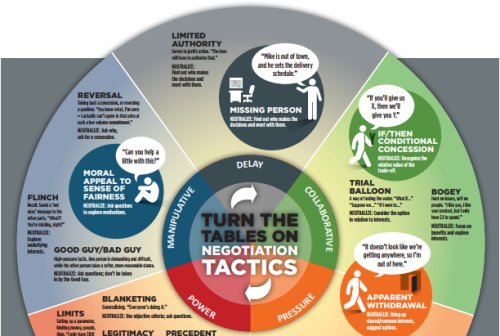
- Tactics: Specific approaches to how you will present your arguments (i.e. negotiation strategies) in a convincing way.
- Response to tactics: Predict the other side's tactics and plan your reactions and counter-tactics.
- Room to move: Be prepared with some pre-determined options to provide you with flexibility in what is asked and offered.
Negotiating is the art of convincing the other side that you should get what you want. Being prepared for effective negotiation involves a lot more than just knowing what you want. Effective negotiation strategies mean knowing what you would settle for and how you are going to convince the other side to give it to you.
Comprehensive negotiation strategies include prepared reactions to the strategy and tactics of the other side. When you take the time to predict what the other side is likely to want and do and then integrate these predictions into your negotiation strategy, you are among those rare individuals who truly are prepared for negotiations.
Negotiation is a contest. Fortune favours the prepared mind (and negotiator). If you want to be a winner, be properly prepared.