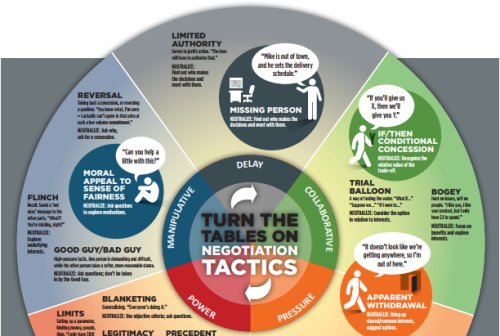
Sales professionals really don't like to enter into a negotiation naked. When you don't have any authority to make concessions, you basically feel pretty naked. Likewise, if you have full authority, then you've got a whole other set of problems.
Back to the poor sales negotiator who has no authority. Hold on a minute, they actually do have a lot of authority. Here's what they have:
- the authority to collect information and represent the other side of the table back within his organization.
- the authority to attempt to create a "both win" type of negotiation.
- the authority to establish both support and commitment with the other side of the table.
- the authority to deal with different members of his organization in the role of a specialist.
- the authority to try to reach a deal on a personal level.
The sales professional is really only prevented from giving in to any of the other side's demands. Since he / she still has the ability to negotiate, it's worth the effort because there is the possibility that the other side will make concessions and a deal can be struck, or at least valuable information about the other side will be collected.
If you've ever been in a no authority sales negotiation situation, then you've probably dreamed of having the ability of being in a sales negotiation where you had full authority. Careful what you wish for - this isn't all that it's cracked up to be.
The reason that full authority is not necessarily what you either want or need is because the name is actually misleading. Full authority simply means that whatever you agree to is what your side of the table will end up having to do. This can lead to disaster. Here are some reasons why you might not want to have full authority when you enter a negotiation:
- Both sides of the table may not have equal authority.
- Both sides of the table may differ in stamina or physical qualities.
- Either side may not be properly prepared.
- Either side may be role playing.
- A side may be more secure than the other.
- A side may be busier than the other.
- A side might be more wealthy than the other.
- A side might be more emotionally involved than the other.
- Either side may have better support staff.
Should you find yourself in a sales negotiation with full authority, all is not lost. There are several ways that you can get out of this predicament. Here are a couple of suggestions:
- Say that you are not familiar with how things operate.
- Indicate that you will need to check with the board of directors.
- State that there is a legal problem.
- State that you need to check with a government agency.
- Say that this may involve anti-trust issues.
- Indicate that this deal actually depends on another deal that is currently being negotiated separately.
- State that you have to tell your coworker / partner.
If none of these "escape" techniques work for you, you can always fall back on the old reliable - "I don't know". You may feel foolish for saying it, but at least you won't end up negotiating a bad deal.